If you are an Australian founder trying to budget your first build, "how much does an MVP cost in Australia?" is one of the hardest questions to get a straight answer to. Search around and you will see numbers from a few thousand dollars to well over six figures, which is not much help when you are trying to plan your runway.
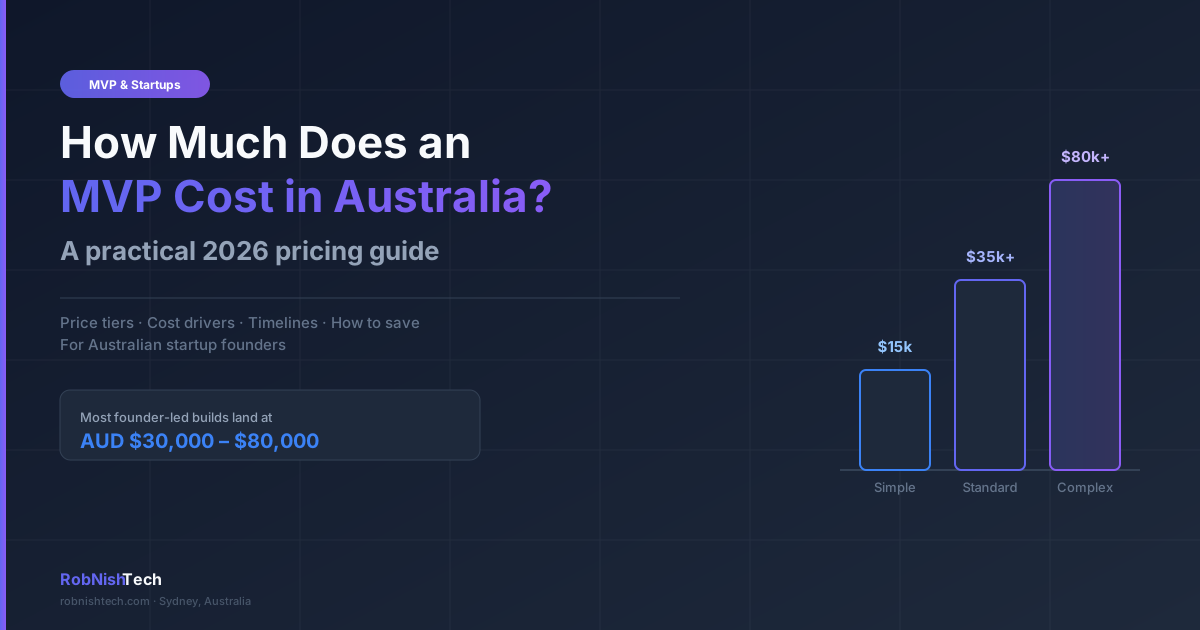
The honest answer is that MVP development cost in Australia usually falls between AUD $15,000 and $120,000 in 2026, with most founder-led builds landing somewhere in the $30,000 to $80,000 range. The spread is wide because an "MVP" can mean a single-screen tool or a multi-role platform with payments and integrations. This guide breaks down the realistic price tiers, what actually moves the number, how long a build takes, and how to keep your spend disciplined so you validate the idea before you spend the big money.
What an MVP Actually Is
A minimum viable product is the smallest version of your product that lets real users complete one valuable workflow end to end. It is not a prototype, not a demo, and not a stripped-back version of every feature you eventually want. It is a focused, working product that tests whether people will actually use and pay for what you are building.
That definition matters for cost, because the most expensive mistake founders make is treating the MVP as version one of the full product. When the MVP carries the weight of every feature on the roadmap, the budget balloons and the timeline slips. A true MVP defers most features on purpose so you can learn quickly and cheaply.
Key Takeaway
The price of an MVP is set far more by scope than by hourly rates. The tighter and clearer your feature list, the more predictable and lower your cost. A vague brief is the single biggest cause of blown MVP budgets.
How Much Does an MVP Cost in Australia?
There is no single MVP price, but builds tend to cluster into three tiers. The ranges below are indicative for 2026 and assume a professional Australian development team. Your actual quote will depend on scope, integrations, and reliability requirements.
| MVP Tier | Typical AUD Range | What You Get |
|---|---|---|
| Simple MVP | $15,000 – $35,000 | One core workflow, a single platform (web or mobile), basic user accounts, minimal integrations |
| Standard MVP | $35,000 – $80,000 | Several connected features, multiple user roles, payments, a few integrations, a polished interface |
| Complex / regulated MVP | $80,000 – $150,000+ | Multi-platform, heavy integrations, complex permissions, or fintech/health-grade compliance and security |
A few things are worth calling out. A simple MVP is genuinely achievable in the low tens of thousands when scope is disciplined and you build for one platform first. A standard MVP is where most validated startup ideas sit once you account for payments, real user management, and a handful of integrations. The complex tier is driven less by feature count and more by regulation: a fintech or healthcare product can start at $80,000 and climb past $150,000 before a single user-facing feature exists, purely because of the security and compliance architecture underneath it.
If you want the wider context on software pricing beyond MVPs, our guide on how much custom software costs in Australia covers the full picture, including business applications and SaaS platforms.
What Drives the Cost of an MVP
Two founders describing the "same" app often get quotes that differ by tens of thousands of dollars. The gap almost always comes down to these drivers.
Scope and feature count. Every screen, user role, and edge case adds design, build, and testing time. The difference between "users can log in and book a service" and "users, admins, and providers each have their own dashboards with approvals" is enormous.
Number of platforms. Building for web and mobile at the same time can add 30 to 40 per cent to the cost compared to launching on one platform first. Most MVPs do not need both on day one.
Integrations. Connecting to payment providers, accounting tools like Xero, CRMs, or third-party APIs each add work and testing. The integration itself is often straightforward; handling the failure cases, syncing, and reconciliation is where the hours go.
User roles and permissions. A single type of user is cheap. Multiple roles with different access rules multiply the screens and logic you need to build and test.
Reliability and compliance requirements. Handling payments, personal data, or health information raises the bar on security, testing, and architecture. This is the main reason regulated MVPs cost more.
Design expectations. A clean, functional interface is part of any serious MVP. A heavily branded, animation-rich experience is a polish investment that can wait until after validation.
Where the Budget Actually Goes
It helps to see roughly how an MVP budget is spent, because it explains why "just add one more feature" is rarely cheap. A typical professional MVP build splits across these areas:
- Discovery and planning (around 10–15%): mapping the workflow, prioritising features, and producing a costed plan before anyone writes code. Skipping this is the most common cause of overspend.
- UX and interface design (around 15–20%): wireframes and the screens users actually interact with.
- Frontend and backend development (around 45–55%): the bulk of the work, building the features, data, and logic.
- Integrations and infrastructure (around 10–15%): payments, third-party services, hosting, and deployment.
- Testing, fixes, and launch (around 10–15%): making sure it works before real users touch it.
A short, structured discovery phase is the cheapest insurance you can buy. It turns a vague idea into a clear, prioritised, costed plan, which is exactly what makes the rest of the build predictable. You can see how we approach this in our development process.
How Long Does an MVP Take to Build?
Timeline and cost are linked, because most of an MVP budget is people's time. As a rough guide for 2026:
- A simple MVP often ships in 4 to 8 weeks once scope is locked.
- A standard MVP usually takes 8 to 12 weeks.
- A complex or regulated MVP commonly runs 12 weeks or more, sometimes phased across several releases.
The single biggest factor in hitting a timeline is decision speed. Builds slow down when scope keeps changing or approvals take weeks. A disciplined scope and a clear point of contact on your side keep both the timeline and the cost under control. For more on what to expect at each stage, our software development timeline guide walks through the phases in detail.
How to Build an MVP Without Overspending
You control more of the budget than you might think. The founders who get the most for their money do a few things consistently.
Prioritise ruthlessly. Separate what the product must do from what would be nice. A simple Must / Should / Could exercise often cuts 30 to 50 per cent of an initial wishlist without hurting the core value. Our guide on MVP feature prioritisation shows how to do this properly.
Build for one platform first. Launch on web or mobile, learn from real users, then expand. You rarely need both to validate demand.
Defer integrations you do not need yet. If you can validate the idea with a manual step in the background, do that first and automate later.
Invest in discovery, not in guessing. A small upfront planning spend prevents the expensive rework that comes from building the wrong thing.
Plan for what comes after launch. Budget for a few weeks of fixes and small improvements once real users arrive. An MVP that nobody maintains stalls quickly.
Key Takeaway
The cheapest MVP is not the one with the smallest quote. It is the one with the clearest scope, built for a single platform, with the right features deferred. Discipline before the build saves more money than any discount during it.
Your Options for Building an MVP
How you build also shapes the cost.
No-code tools can be the cheapest and fastest path for very early validation or a genuinely simple product. They become a constraint when you need custom logic, control over your data, specific integrations, or room to scale. Many Australian founders start no-code to test demand, then move to a custom build once the idea is proven.
Freelancers can be cost-effective for a small, well-defined piece of work, but coordinating design, frontend, backend, and testing across individuals adds management overhead and risk for a full MVP.
A development partner or agency costs more per hour but typically delivers a complete, supportable MVP with design, build, testing, and deployment handled together. For most founders building something they intend to grow, this is the lower-risk path. Our MVP and SaaS development and custom software development services are built around exactly this kind of focused, validation-first delivery.
Whichever route you choose, the principle is the same: spend the smallest amount that lets real users prove the idea, then invest the larger budget with confidence. If you are weighing up a build and want a realistic estimate for your specific idea, get in touch and we will help you scope it.
Frequently Asked Questions
How much does an MVP cost in Australia in 2026?
A simple MVP usually costs between AUD $15,000 and $35,000, a standard market-ready MVP around AUD $35,000 to $80,000, and a complex or regulated MVP from AUD $80,000 into six figures. The final number depends on scope, integrations, and how many platforms you support.
Can you build an MVP for under $20,000?
Sometimes, yes. A single-platform MVP with one core workflow, a small feature set, and no heavy integrations can land under AUD $20,000. The trade-off is fewer features and tighter scope. The risk is trying to fit too much into a small budget, which usually produces a fragile product rather than a focused one.
Why do MVP quotes vary so much?
Most variation comes from scope, not hourly rates. Two founders describing the "same" app often mean very different things once you map screens, user roles, integrations, and edge cases. A vague brief produces vague quotes. A clear, prioritised feature list produces quotes you can actually compare.
How long does it take to build an MVP?
A focused MVP typically takes 6 to 12 weeks once scope is agreed. Simple builds can ship in around 4 to 8 weeks, while products with multiple user roles, payments, or several integrations often run 12 weeks or more. A discovery phase before the build helps lock the timeline.
What is the difference between MVP cost and full product cost?
An MVP is the smallest version that lets real users complete one valuable workflow, so it costs a fraction of a full product. The full product adds the features, polish, scale, and edge-case handling you defer during the MVP. Building the MVP first means you spend the larger budget only after the market validates the idea.
Is it cheaper to use no-code for an MVP?
No-code can be cheaper and faster for very simple MVPs or early validation. It becomes a constraint when you need custom logic, control over your data, specific integrations, or room to scale. Many Australian founders start no-code to test demand, then move to a custom build once the idea is proven.
Need Help With Your Next Project?
We build custom software, integrate AI, and automate workflows for businesses across Australia.
Get in Touch